“Studies pause. RODs get rescinded and reissued once new studies and EIS are done. Congressional authorization isn’t so easily cancelled.”
— Robert Spurlock, President/Executive Director of TransAmerica Corridor, Inc.
Setting the Record Straight: The East-West TransAmerica Corridor Is Not Cancelled
By Robert Spurlock
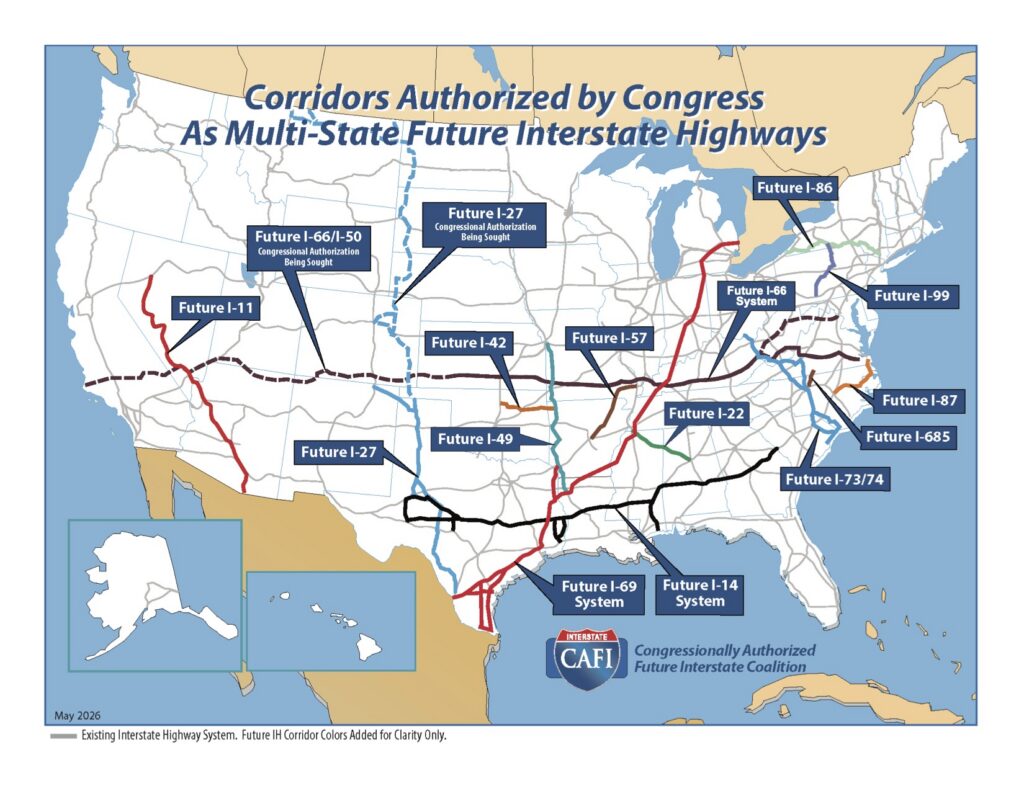
Recently, inaccurate claims have circulated online about the status of the East-West TransAmerica Corridor (Congressional High Priority Corridor 3), encompassing Future I-66 (and soon Future I-50). As always, we believe our supporters, partners, and the public deserve the facts, straight from the federal record. Below, we address the most significant claims point by point, with sources.
THE CORRIDOR’S CONGRESSIONAL DESIGNATION HAS NEVER BEEN WITHDRAWN
The East-West TransAmerica Corridor was established as a High Priority Corridor under the Intermodal Surface Transportation Efficiency Act of 1991 (ISTEA, P.L. 102-240) and reaffirmed in the National Highway System Designation Act of 1995 (P.L. 104-59). It has since been amended, most recently through Moving Ahead for Progress in the 21st Century Act (MAP-21) in 2012. Removing a congressionally designated High Priority Corridor requires an Act of Congress. That has not happened, and no such repeal exists in the federal record.
WHAT WAS ACTUALLY CANCELLED: THREE SPECIFIC ELEMENTS, NOT THE CORRIDOR
Critics have pointed to two real federal actions and used them to imply the entire corridor was scrapped. Here is what the record actually shows:
2015 — Illinois Tier 1 EIS Study Discontinued. The “66 Corridor Tier 1 EIS Study,” covering the Illinois portion of the route between Paducah, KY and Cape Girardeau, MO, was discontinued in 2015. The Kentucky Transportation Cabinet withdrew from the study, citing the state’s prioritization of I-69 completion and a lack of available funding at the time. This was not a determination that the corridor itself lacked merit or authorization.
2018 — Record of Decision Rescinded for One Segment. On June 15, 2018, FHWA’s Kentucky Division, in cooperation with the Kentucky Transportation Cabinet, rescinded the 2003 Record of Decision (ROD) and Final Environmental Impact Statement (FEIS) covering a specific segment of Interstate 66 in Pike County, Kentucky, and Mingo County, West Virginia (Federal Register notice, FR Doc. 2018-13332). The notice cited four reasons: no foreseeable connection to the King Coal Highway; significant impacts associated with the 2003 Selected Alternative; other regional improvements meeting the project’s purpose and need; and a lack of construction funding.
2018 — Notice of Intent Rescinded for One Segment. Just over two weeks later, on July 2, 2018, the same FHWA Kentucky Division official rescinded a separate, 2002 Notice of Intent (NOI) to prepare an EIS for a distinct segment of new I-66 construction between the Somerset Northern Bypass (I-66) and London, Kentucky (Federal Register notice, FR Doc. 2018-14157). A Draft EIS for this segment had actually been completed and signed in 2006 before the NOI was rescinded twelve years later, citing a lack of future programmed funding. As with the other 2018 notice, FHWA confirmed that any future federal-aided action in the corridor would proceed under standard NEPA and FHWA environmental review, leaving the door open to a new study rather than closing it.
None of the above actions touched the corridor’s congressional designation. Both were study (and project-level decisions) the kind that are common and routinely revisited in statewide transportation improvement plans as conditions change on large multi-decade infrastructure corridors.
CONDITIONS CITED IN 2018 HAVE CHANGED
The 2018 rescission notice is not a permanent verdict. It explicitly states that any future federal-aided action in the corridor will proceed under standard environmental review requirements (NEPA, 42 U.S.C. 4321; FHWA regulations, 23 CFR 771). In other words, the door to a new Environmental Impact Statement was never closed.
Meaningfully, one of the four reasons cited in 2018 (the lack of a foreseeable connection to the King Coal Highway) no longer reflects current conditions.
Significant segments of the King Coal Highway are now open to traffic or under active, funded construction, including the Montcalm-to-Littlesburg section, which carries its own federal funding source (Federal Project STBG 2025(034)D). Federal funding pathways more broadly have also expanded since 2018, through the BUILD America 250 Act and the CAFI Coalition’s work securing Future Interstate eligibility for existing and new federal grant programs, including the STAG discretionary grant program.
THE CORRIDOR’S STATUTORY ROUTE HAS NEVER BEEN NARROWED
Some claims suggest Congress limited the corridor to a short list of existing state highways, or dropped Virginia and the western states from the route. Neither is accurate. The current statutory definition of Corridor 3, as amended through MAP-21, describes a route commencing in the Hampton Roads area of Virginia, continuing west through Lynchburg and Roanoke, into a West Virginia corridor centered on Beckley to Welch (the Coalfields Expressway), to Williamson (sharing a common corridor with I-73/74), through a Kentucky corridor centered on Pikeville, Jenkins, Hazard, London, and Somerset, then to Bowling Green, Hopkinsville, Benton, and Paducah, into Illinois and Missouri, and westward across southern Kansas.
This is the full, current, congressionally defined route, not a truncated version ending at any single state line. Where the route in West Virginia shares a common alignment with Future I-73/74 near Williamson, that reflects routine FHWA practice: concurrent interstate designations on a shared roadway are common nationwide and do not indicate any confusion or conflict about the corridor’s identity or status.
The FHWA markup [I-66] was added near the Somerset segment because it was the highway closest to achieving interstate standards in the mid-1990s when this statutory route was assigned by Congress.
It’s also worth noting what “ends in Kansas” does and doesn’t mean. The current statutory text for Corridor 3 does stop in southern Kansas, but the federal High Priority Corridor system was never intended to strand the route there. Corridor 3 was designated to connect at that point with High Priority Corridor 51 (the “Spirit Corridor”), continuing on to I-40, which would complete a coast-to-coast link.
So while the statutory route as written today ends in Kansas, the broader federal corridor framework already contemplated coast-to-coast functionality through that connection. TAC’s western amendment effort is aimed at formally adding those original western segments into Corridor 3’s own statutory route, and a related eastern cleanup effort is aimed at resolving the numbering logic for the Williamson-to-Norfolk segment (using a designation such as Future I-50) so that the corridor’s numbering makes sense relative to I-64 and I-66 along its full length.
Both of these are amendments TAC is actively pursuing, not claims about the corridor’s current legal status.
VIRGINIA LOCALITIES AND LEGISLATORS ACTIVELY SUPPORTED THE CORRIDOR
Some claims suggest Virginia never had any interest in the corridor. The public record says otherwise, at multiple levels of government.
Local government: Official minutes from the Dinwiddie County Board of Supervisors, dated May 19, 1999, document that the Virginia portion of the TransAmerica Corridor Study (a VDOT-led planning effort examining U.S. Route 460 from Roanoke to the Ports of Hampton Roads) began in April 1997 and completed its first phase in the fall of 1998. At that May 1999 meeting, the Dinwiddie Board unanimously adopted a resolution supporting continued state funding for the study’s next phase, and directed that the resolution be forwarded to the region’s legislative delegation and the Commonwealth Transportation Board ahead of a statewide appropriations hearing. Board members also referenced a coordinated, multi-locality effort, with resolutions of support from several jurisdictions bound together for presentation to the full Transportation Committee.
Virginia Beach City Council received a direct briefing on the TransAmerica Corridor on June 24, 1997, from Assistant City Manager Robert Matthias and Chris Lloyd of Baker Environmental (the firm then under contract to study the corridor), and an affiliate of Michael Baker Jr., International. That briefing confirms several details of the corridor’s history: the concept originated from a nationwide feasibility study identifying a corridor between I-70 and I-40 (topically named “I-66”), the 1994 Coast-to-Coast Feasibility Study found a single continuous facility infeasible but identified components that could be feasible in certain states, and Virginia and West Virginia specifically elected to pursue the corridor within their jurisdictions following that finding. As of 1997, Baker Environmental was actively evaluating the corridor between Beckley, WV and Virginia Beach, coordinating with VDOT and FHWA.
VDOT’s study of the Virginia segment was conducted in partnership with Chris Lloyd and Michael Baker Jr., International. We note for the record that TAC has made multiple requests to both VDOT and Michael Baker International for archival copies of this study, and both organizations have confirmed that, after roughly 30 years, the original study documents are no longer retained in their archives. We rely here on the contemporaneous public records that do survive (including the meeting minutes and legislative resolutions cited throughout this article) as the best available documentation of the study’s history and findings.
The Virginia General Assembly: Senate Joint Resolution No. 95 was introduced on January 22, 1996, by Senator Newman and Delegates Bryant and Griffith, expressing the sense of the General Assembly that VDOT, under the direction of the Commonwealth Transportation Board, should “actively encourage and expeditiously undertake the construction of Virginia’s segment of the Trans-America Highway through Virginia.” The resolution was referred to the Committee on Rules. We note this resolution’s final legislative disposition is not reflected in our current records, but its formal introduction by three Virginia legislators is itself a clear, on-the-record marker of state-level legislative interest in advancing the corridor.
Together, these records span local, regional, and state government in Virginia, actively engaging with and advocating for the corridor’s study and construction, not the disinterest some claims suggest.
KENTUCKY AND KANSAS HAVE ALSO ACTIVELY INVESTED IN THE CORRIDOR
Kentucky continues to fund I-66 construction with federal dollars today, and has for years. This reflects a nearly three-decade progression rather than a revived or abandoned effort (though it did disappear from the Kentucky Highway Plan from about 2008-2023). The Somerset I-66 Northern Bypass was identified as the top-priority segment of the Southern Kentucky Corridor in KYTC’s 1997 Economic Feasibility Study, refined through a dedicated 2000 planning study, and is now under active, funded construction. Both the 2024 Enacted Highway Plan (FY2024–2030) and the 2026-2032 Six-Year Highway Plan list active items for this segment explicitly titled “SOMERSET NORTHERN BYPASS (I-66).” The 2024 plan carries two such items: Section 3 (Item #8-59.50, $110.55 million) and Section 4 (Item #8-59.60, $105.97 million). Both are funded through federal National Highway System (NH) dollars and both referencing an associated BUILD Grant item. The 2026-2032 plan carries these same sections forward and adds a newly funded Item #8-59.70, also titled “Somerset Northern Bypass (I-66),” with $56.26 million in federal Kentucky Discretionary (KYD) funding for utilities and construction beginning in FY2026, alongside a noted $45 million Congressional earmark tied to the same Somerset Northern Bypass sections. These are current, funded, federal-dollar commitments to completing a named I-66 segment across consecutive highway plans, not aspirational planning entries.
Kansas partnered with the Federal Highway Administration on a dedicated study of its own segment of the corridor as early as 1996. In testimony before the Kansas Senate Committee on Transportation and Utilities on February 1, 1996, Secretary of Transportation Dean Carlson explained that KDOT had received a federal grant “specifically for further study of a specific segment of the Transamerica Transportation Corridor (TTC) which was studied by the Federal Highway Administration in 1993 and 1994,” describing the TTC as “a major east-west transportation corridor from Virginia to California, through the nation’s midsection.” The Kansas Turnpike Authority agreed to serve as a formal partner in that study, providing half of the required matching funds. KTA President and CEO Michael Johnston reinforced this in his own testimony that day, describing KTA’s role “as a partner with KDOT and FHWA in a project to gather data for the Kansas segment of the Transamerica Transportation Corridor.”
Taken together, the current, federally funded Somerset Northern Bypass (I-66) work described above and the funded progress on the King Coal Highway point to the same conclusion: the 2018 rescission made sense given the conditions at the time, but those conditions have manifestly changed.
The 2018 notice itself did not foreclose the corridor’s future. It explicitly stated that any future federal-aided action would proceed under standard NEPA and FHWA environmental review, meaning a new study and a new Record of Decision were always understood as possible for this specific corridor once circumstances warranted it. With active federal funding now flowing to I-66 construction in Kentucky and the King Coal Highway connection substantially further along than it was in 2018, the case for revisiting that corridor with a new study is stronger today than it has been at any point since the rescission.
CONGRESS IS CURRENTLY EXPANDING THE CORRIDOR’S FUNDING ELIGIBILITY, NOT WITHDRAWING IT
Far from moving to eliminate Future Interstate corridors, Congress is actively working to expand how they can be funded. The East-West TransAmerica Corridor (Future I-66 System) is one of 14 congressionally authorized multi-state Future Interstate corridors nationwide, represented in Congress by the Congressionally Authorized Future Interstate (CAFI) Coalition. As of May 2026, the CAFI Coalition (a national alliance including the Alliance for I-69 Texas, the I-27 Ports-to-Plains Alliance, and the I-14 Gulf Coast Strategic Highway Coalition, with support from dozens of cities, counties, and regional organizations across more than 20 states) secured an amendment to the BUILD America 250 Act making these corridors newly eligible for an existing federal formula program, an existing federal grant program, and the new STAG discretionary grant program.
That amendment passed the House Transportation and Infrastructure Committee by a 62–2 vote in May 2026. A dedicated Multi-State Future Interstate Highway Formula Funding Program (which would provide guaranteed, formula-based federal construction funding tied to each state’s unconstructed Future Interstate mileage) is still being pursued in the Senate ahead of the Act’s September 30, 2026 reauthorization deadline.
None of this is the posture of a Congress treating these corridors, or this one specifically, as abandoned. It is the posture of a Congress actively building new, dedicated funding pathways for their completion.
We’ll also note that current, active support for advancing this corridor continues to come in from local governments, chambers of commerce, and regional economic development organizations across multiple states. This is consistent with the historical pattern of local and state support documented throughout this article.
DESIGNATION IS NOT THE SAME THING AS A FEDERAL MANDATE TO BUILD
One claim circulating is technically accurate but doesn’t mean what it’s being used to suggest: the federal government cannot force a state to build a highway. States hold constitutional authority over their own transportation infrastructure, and Congress cannot compel a state department of transportation to construct any specific project, including a segment of a congressionally designated corridor.
That’s true, and TAC has never claimed otherwise. But it doesn’t bear on the actual point in dispute. A congressional designation and a federal construction mandate are two entirely different things. High Priority Corridor 3’s designation establishes the corridor’s eligibility for federal planning and construction funding, and signals congressional intent for the route. It does not, and was never intended to, force any state to build it on any particular timeline.
States retaining the choice of whether and when to advance construction is not evidence that the corridor’s designation has been cancelled; it’s simply how the federal-state highway system has always worked, for every corridor, everywhere. The fact that Kentucky, Illinois, Missouri, Kansas, Virginia, and other states have (as documented throughout this article) actively chosen to study, fund, and advance this corridor over multiple decades, without any federal mandate requiring them to do so, is itself evidence of the corridor’s ongoing viability, not a technicality that undermines it.
A second, related Federal Register notice (issued the same week in 2018 by the same FHWA Kentucky Division official) rescinded a separate 2002 Notice of Intent to prepare an EIS for new I-66 construction between the Somerset Northern Bypass (I-66) and London, Kentucky, citing potential environmental impacts and a lack of programmed funding, with the same standard language preserving the option of future NEPA review. That rescinded segment picks up exactly where the Somerset Northern Bypass ends. The bypass itself, the anchor point for that future segment, is the same project now fully funded and under construction.
That connection is more than coincidental. The Somerset Northern Bypass (I-66) is engineered to terminate at a new KY-80/Hal Rogers Parkway/KY-461 interchange, tying directly into the Hal Rogers Parkway to the east. KYTC’s own 2000 Southern Kentucky Corridor (I-66) Planning Study specifically discussed using portions of the KY 80 corridor between Somerset and London as a possible I-66 alignment. Today, multiple funded items in the current highway plan are upgrading the Hal Rogers Parkway itself to interstate standards between Somerset and Hazard, with design, right-of-way, and construction funding phased through 2030.
The interchange connection and the Hal Rogers Parkway upgrade are current, funded facts; a future I-66 designation specifically along KY 80 remains a planning option under study rather than a funded commitment, but the pieces are visibly being assembled in that direction.
STIP STATUS AND CHANGING PRIORITIES
A related claim holds that if a project isn’t listed on a state’s Statewide Transportation Improvement Program (STIP), it has been “cancelled” by that state. A STIP is a near-term programming document (typically covering a four-year funding window) for projects with committed, currently phased funding. Projects move on and off STIPs routinely as funding phases shift; that movement reflects normal program timing, not a permanent legal determination that a project is dead.
By this same standard, the record already laid out in this post cuts the other way for Kentucky. The Somerset Northern Bypass (I-66) items are funded construction projects in Kentucky’s current Six-Year Highway Plan and 2024 Enacted Highway Plan, and a state’s Six-Year Plan is the direct feeder document into its STIP.
In fact, Kentucky’s current Statewide Transportation Improvement Program (FY 2025-2028) lists the Somerset Northern Bypass (I-66), Item #8-59.6, by that exact name five separate times, across its Design, Right-of-Way, Utility, and Construction phases, with construction funded for FY2028 through National Highway System (NH) dollars. If STIP presence is the test being proposed, Kentucky’s own current STIP shows I-66 passing that test today, by name, in black and white.
Some may suggest “I-66” is simply a legacy name attached to these projects with no bearing on the corridor’s actual status. The funding record says otherwise. These items are coded through federal Interstate Funds (IF) and National Highway System (NH) categories (funding streams that exist because of interstate and NHS eligibility, not despite it) and are tied to an active federal BUILD Grant application requiring a currently justified transportation purpose.
The same “I-66” designation has been carried consistently through nearly three decades of formal federal and state action, from the 1997 and 2000 feasibility and planning studies, through the 2003 Record of Decision and 2018 rescission notices, to the funded construction items in Kentucky’s current highway plan and STIP today. A name doesn’t get renewed through a federal grant application and coded into interstate-specific funding categories by accident.
It’s also worth noting that a congressional interstate designation is not merely “authorization to use a number,” as some claims suggest. Designation determines eligibility for specific categories of federal-aid highway funding — the Kentucky funding already documented above is coded through Interstate Funds (IF) and National Highway System (NH) categories, funding streams tied directly to that designation.
A NOTE ON PROPOSED ELEMENTS: CORRIDOR H AND FUTURE I-50
For transparency, as we’ve stated on our About and FAQ pages: TransAmerica Corridor, Inc.’s reference to Corridor H as a potential western West Virginia connection, and our use of “Future I-50” for the Virginia segment, are proposals originated by our organization, not claims of existing federal designation. The I-50 designation reflects FHWA’s interstate numbering grid conventions (keeping the corridor’s numbering logically positioned relative to I-64), a technical and administrative consideration.
This numbering structure also resolves a genuine historical issue. An existing Interstate 66 already runs through Northern Virginia, unrelated to this corridor. Under TAC’s current proposal, the corridor’s Virginia segment (running from Norfolk to Williamson, West Virginia) is designated Future I-50, not I-66; the Future I-66 designation only applies from Williamson westward through Kentucky and beyond. Because this routing runs nowhere near Northern Virginia, there is no numbering conflict with the existing I-66 under the current proposal. Earlier, pre-refinement versions of the corridor concept may have used “I-66” as a placeholder for the full route, including the Virginia segment, which could explain claims of a historical numbering conflict, but that is not how the corridor is proposed today.
THE BOTTOM LINE
The East-West TransAmerica Corridor’s congressional authorization stands. What has changed over the past decade are specific studies and project-level decisions (normal, expected developments for a multi-decade, multi-state infrastructure corridor) and several of the conditions that led to those 2015 and 2018 actions have since shifted in the corridor’s favor. We welcome scrutiny of this project. It’s why TAC has painstakingly rebuilt its archive on the corridor’s history to showcase the full record. Every document cited in this post is publicly available, drawn directly from federal, state, or local government sources, and can be found in the TAC Corridor Data Archive. We ask only that any scrutiny of this project be measured against that actual record, which we’ve laid out here in full, with sources.
Learn more on our About and FAQs and Corridor Data pages.
Robert Spurlock is the President/Executive Director of TransAmerica Corridor, Inc. To learn more about the organization visit www.transamericacorridor.com or contact him at Robert.Spurlock@transamericacorridor.com.
Sources:
- ISTEA, P.L. 102-240, Section 1105 (1991)
- National Highway System Designation Act, P.L. 104-59 (1995)
- Moving Ahead for Progress in the 21st Century Act (MAP-21), P.L. 112-141 (2012)
- 66 Corridor Purpose and Need Statement and Logical Termini Memorandum (2014–2015)
- Federal Register, FR Doc. 2018-13332 (June 15, 2018), FHWA Kentucky Division
- Federal Register, FR Doc. 2018-14157 (July 2, 2018), FHWA Kentucky Division
- KYTC Southern Kentucky Corridor (I-66) Planning Study, Final Report, 2000
- KYTC Professional Services Procurement Bulletin 2024-11, Pulaski | 8-59.50 & 8-59.60 | LN-9008
- Hal Rogers Parkway Final Report (KYTC)
- WVDOH/FHWA King Coal Highway public project materials, Montcalm to Littlesburg section
- 1994 Transamerica Transportation Corridor Feasibility Study, Wilbur Smith Associates / HNTB
- Dinwiddie County, Virginia Board of Supervisors, Official Meeting Minutes, May 19, 1999
- Virginia Beach City Council, Official Meeting Minutes, June 24, 1997
- Virginia Senate Joint Resolution No. 95, introduced January 22, 1996
- Kentucky Transportation Cabinet, 2024 Enacted Highway Plan (FY2024-2030), and 2026-2032 Six-Year Highway Plan
- Kentucky Statewide Transportation Improvement Program (STIP), FY 2025-2028
- Congressionally Authorized Future Interstate (CAFI) Coalition, program materials, May 2026
- Kansas Senate Committee on Transportation and Utilities, Meeting Minutes and Testimony, February 1, 1996
more news
CAFI Press Release
FOR IMMEDIATE RELEASE East-West TransAmerica Corridor Added to Congressionally Authorized Future Interstate Coalition Map TransAmerica Corridor, Inc. joins national CAFI initiative supporting dedicated federal funding for…
READ MOREThe Rebirth of a Corridor
“The future of the regions in between I-70 and I-40, including southeast Missouri where this project originated, will be decided by what we do now…
READ MORE