“It’s a generational project.”
— Ed Compton, West Virginia Deputy State Highway Engineer.
Virginia and West Virginia Officials Look To Connect the Coalfields Expressway
By Robert Spurlock
Officials from Virginia and West Virginia met in Princeton, West Virginia, on August 31 to compare notes on the Coalfields Expressway (U.S. Route 121) — a decades-old, limited-access highway project meant to link the coal-producing regions of Southwest Virginia and southern West Virginia to the broader interstate system. Representatives from the Virginia Coalfields Expressway Authority, the Virginia Department of Transportation, and the West Virginia Department of Transportation attended, along with Virginia Del. Will Morefield and a representative from U.S. Sen. Mark Warner’s office.
The completed route would ultimately connect Interstates 64 and 77 in West Virginia with U.S. 460 and U.S. 23 near Pound, Virginia. This opens up a mountainous region that has long lacked modern highway access for industrial development, tourism, and interstate commerce.
VIRGINIA: 42 MILES STILL UNFUNDED
Virginia Coalfields Expressway Authority Executive Director Jonathan Belcher told the group that funding gaps and the challenge of coordinating a project across two states remain the biggest obstacles. By next year, roughly 14 miles of U.S. 121/460 in Buchanan County should be complete, but about 42 miles of the Virginia corridor still have no funding source.
Some recent progress:
- A $1.6 million Abandoned Mine Land Economic Revitalization grant rounded out funding to widen a four-mile section of the Route 460 Connector near Breaks Interstate Park to four lanes (construction targeted for late 2029).
- The state budget includes $7 million for the expressway, with another $3 million in federal funding reportedly expected.
- VDOT’s final two miles of the Corridor Q overlap section, between Poplar Creek Road and Grundy, are under construction and due for completion in late 2027.
VDOT’s latest estimate puts the cost to finish Virginia’s remaining sections at roughly $2.5 billion.
WEST VIRGINIA: BUILDING OUT FROM WELCH TO BECKLEY
West Virginia’s construction strategy has centered on the stretch between Welch and Beckley. About 18 miles are now open between Mullens and the Sophia area near Beckley, according to Deputy State Highway Engineer Ed Compton. Farther south, the state awarded a $72.5 million contract in October 2025 for work near Pineville and Twin Falls State Park, and a five-mile section near Welch is expected to give McDowell County its first four-lane highway.
The gap that remains: the segment connecting the Welch area to the Virginia state line isn’t yet in West Virginia’s upcoming Statewide Transportation Improvement Program, so that link stays a longer-term goal for now. Compton described the project as a “generational” one, noting some West Virginia segments have been under construction for roughly three decades.
HOW THE WELCH SEGMENT CAME TO BE
That West Virginia progress traces back further than the Princeton meeting. Much of it flows from Gov. Jim Justice’s 2017 Roads to Prosperity Program; a $2.8 billion statewide bond issuance that has funded more than 1,320 projects and revived a Coalfields Expressway that had originally been designed in 1998 but saw only a few miles built before then.
One project that funding made possible is the 5.12-mile Welch-to-WV 16 Interchange section, carrying a $147.6 million construction price tag funded largely through turnpike bonds and federal aid. Bizzack Construction, a Lexington, Kentucky-based earthmoving contractor, has been building the segment since it was let in April 2022; an early-2025 project update projected completion in summer 2026. Note: a late-2027 completion date reported elsewhere refers to Virginia’s separate Poplar Creek Phase B project near Grundy, not this West Virginia segment.
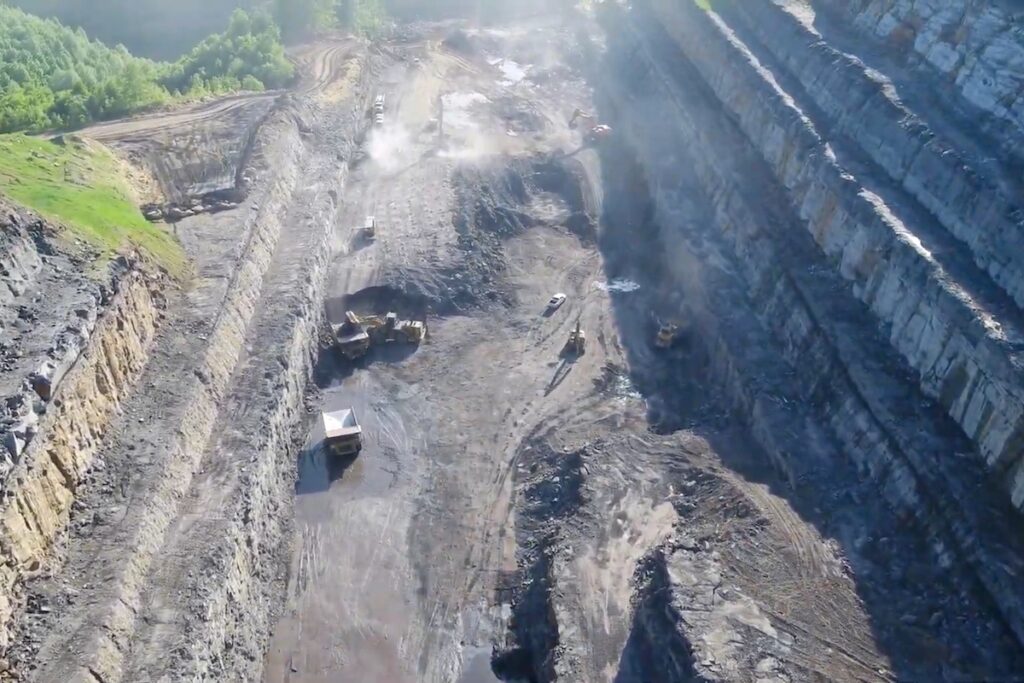
West Virginia DOT District Ten Engineer Ryland Musick has described it as a genuinely difficult greenfield build: the site sits 40 miles from the nearest major road, and crews are moving more than 16 million cubic yards of earth through drilling and blasting to cut a smooth grade through the mountains, all while protecting habitat for federally listed species like the candy darter and several rare crawdad populations found in the area’s streams.
Crews are moving more than 16 million cubic yards of earth to cut this highway through the mountains of McDowell County.
Once complete, the Welch section will connect that community to the already-finished stretch running to Mullens and on to Beckley. It will cut roughly 30 minutes off the drive and, according to Musick, opening up access to jobs, shopping, and services that currently require an hour and a half of travel for many McDowell County residents.
A SHARED FUNDING STRATEGY TAKES SHAPE
Much of the Princeton meeting focused on how the two states might work together rather than continue building in isolated pieces. Ideas on the table included:
- Joint federal grant applications. Belcher noted that a proposal showing benefits across two states could be more competitive than either state applying alone, saying, “The benefit of the highway is connection.”
- Expanding Appalachian Development Highway System (ADHS) designation. Only the portion overlapping U.S. 460 currently carries that designation; draft legislation would add more Coalfields Expressway mileage, which would open the door to Appalachian Regional Commission funding.
- A federal conduit bond mechanism, which Del. Morefield said he would look into as another possible funding source.
- Coal-synergy construction, coordinating highway building with coal extraction and land reclamation to help offset the high cost of earthmoving in the mountainous terrain.
MOMENTUM FROM KENTUCKY
The corridor’s momentum isn’t limited to Virginia and West Virginia. In Kentucky, Congressman Hal Rogers (Dean of the House and Appropriations Chairman Emeritus) has helped secure $82 million in Community Project Funding for the Somerset I-66 Northern Bypass, which will carry the I-66/I-365 designation and is now advancing toward construction. The bypass is actively funded in KYTC’s FY2026–2032 Six-Year Highway Plan and current STIP, with Section 3 (roughly $95 million, FY2027–2028) and Section 4 (roughly $75 million) representing the next funded phases.
Beyond Somerset, Kentucky Senate President Robert Stivers announced in August that state and federal funds have been secured to begin design studies for a four-lane expansion of the Hal Rogers Parkway from London to Hazard. This corridor is a nearly 60-mile stretch through the mountains of Eastern Kentucky that currently runs four lanes in some sections and two in others. Stivers put the design phase alone at more than $50 million, with no construction timetable set yet.
Rep. Hal Rogers, for whom the road was renamed in 2003 after decades as the tolled Daniel Boone Parkway, called the four-laning effort long overdue. Together, this study and the Somerset I-66 Northern Bypass lay the groundwork for a continuous Future I-66 Corridor through this stretch of southeastern Kentucky, mirroring what’s happening farther east on the Coalfields Expressway: real, funded construction and planning advancing a corridor piece by piece, well ahead of any final interstate designation.
PART OF THE TRANSAMERICA CORRIDOR’S STATUTORY ROUTE
This progress matters directly to TransAmerica Corridor, Inc.’s mission. The statutory description of the East-West TransAmerica Corridor (High Priority Corridor 3) names the West Virginia corridor centered on Beckley to Welch as the Coalfields Expressway segment itself, then carries the route on to Williamson, West Virginia, where it shares a common corridor with I-73/74, before continuing into Kentucky through Pikeville, Jenkins, Hazard, London, and Somerset. In other words, the Beckley-to-Welch construction discussed at the Princeton meeting isn’t a separate, unrelated highway project sitting near the TransAmerica Corridor — it is part of the authorized West Virginia leg of the corridor.
That makes the funding gap between Welch and the Virginia state line, and the still-unstudied stretch onward to Williamson and into TransAmerica Corridor, Inc.’s priority Hazard–Pikeville–Williamson segment in Kentucky, directly relevant to completing the broader corridor Congress already authorized. Virginia and West Virginia’s move toward joint federal grant applications (and their strategy of expanding Appalachian Development Highway System designation to unlock Appalachian Regional Commission funding) is a model TransAmerica Corridor, Inc. will be watching closely as it works toward a joint Tier 1 EIS for the same corridor segment.
Construction progress on this Hampton Roads-to-Williamson leg also carries longer-term significance for how the corridor is ultimately numbered. As part of TransAmerica Corridor, Inc.’s ongoing legislative effort to clarify the corridor’s interstate designations, the Hampton Roads-to-Williamson segment (encompassing the Beckley-to-Welch Coalfields Expressway section discussed at the Princeton meeting) is envisioned as a future Interstate 50, merging into Interstate 66 at Williamson, West Virginia, where the corridor continues west through Kentucky. That designation has not been enacted; it remains a legislative goal TransAmerica Corridor, Inc. continues to pursue. But each mile of Coalfields Expressway construction between Beckley and Welch brings that eventual interstate closer to reality on the ground, regardless of what it’s ultimately numbered.
TransAmerica Corridor, Inc. (TAC) is a 501(c)(4) nonprofit advancing completion and extension of the congressionally authorized East-West TransAmerica Corridor (High Priority Corridor 3) from Hampton Roads, Virginia, to San Diego (and one day, San Luis Obispo, California).
Robert Spurlock is the President/Executive Director of TransAmerica Corridor, Inc. To learn more about the organization visit www.transamericacorridor.com or contact him at Robert.Spurlock@transamericacorridor.com.
Sources
- CoalZoom, “West Virginia and Virginia Officials Discuss Coalfields Expressway Progress,” September 7, 2026 https://www.coalzoom.com/article.cfm?articleid=44509
- WYMT, “Hal Rogers Parkway four-lane expansion moves forward with state, federal funding,” August 13, 2026 https://www.wymt.com/2026/08/13/hal-rogers-parkway-four-lane-expansion-moves-forward-with-state-federal-funding/
- Construction (ACP), “West Virginia DOT Paves the Path to Growth With $147M Coalfields Expressway Project,” February 2025 https://acppubs.com/CON/article/42109270-west-virginia-dot-paves-the-path-to-growth-with-147m-coalfields-expressway-project
more news
CONGRESSMAN DEREK SCHMIDT SUPPORT LETTER Press Release
FOR IMMEDIATE RELEASE Congressman Derek Miller Backs Future Interstate 66 Through Southern Kansas Kansas 2nd District Member supports advancing the East-West TransAmerica Corridor through Pittsburg…
READ MORECONGRESSWOMAN CAROL MILLER SUPPORT LETTER Press Release
FOR IMMEDIATE RELEASE Congresswoman Carol Miller Backs East-West TransAmerica Corridor, Becomes First Ways and Means Member to Join National Coalition West Virginia’s First District Representative…
READ MORECONGRESSMAN JAMES COMER SUPPORT LETTER Press Release
FOR IMMEDIATE RELEASE House Oversight Chairman James Comer Issues Letter of Support for the East-West TransAmerica Corridor Kentucky’s 1st District Congressman is the third Member…
READ MORE